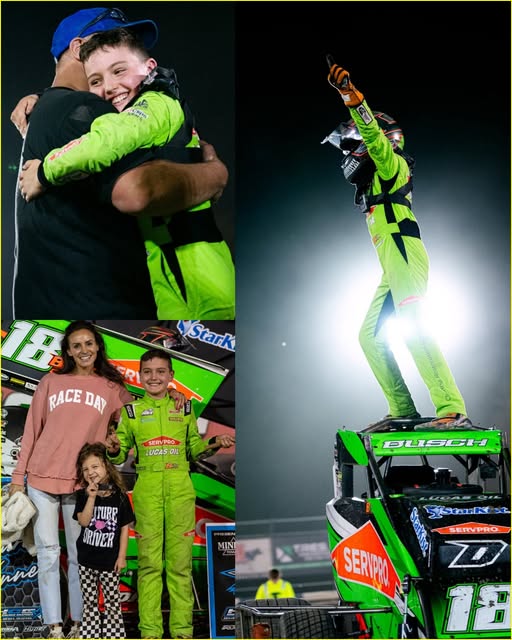
In a season filled with heartbreak and heartbreak, the NASCAR Xfinity Series delivered one of its most electric moments of 2026 on Saturday night at Bristol Motor Speedway. When the checkered flag dropped, 17-year-old Brexton Busch — driving the No. 19 Chevrolet for Joe Gibbs Racing — had rocketed from 11th starting position all the way to a stunning runner-up finish. The victory was not just impressive; it was historic for a teenager in the developmental series, proving that raw talent, blistering speed, and a racing IQ that borders on genius can overcome every obstacle. But what truly shook the entire NASCAR community — and left seasoned veterans speechless — was what happened in the post-race media center.
Instead of the usual teenage jitters or scripted “I’m just happy to be here” answers, Brexton stepped up to the microphone and delivered a masterclass in race strategy, defensive racing, and team management that rivaled the insights of 20-year veterans. Reporters, many of whom had covered Cup Series stars for decades, found themselves asking follow-up questions they hadn’t even considered. “How does a 17-year-old see the whole car like that?” one veteran asked in disbelief. The answer? Brexton wasn’t just lucky. He was operating at a level most pros only dream about.
This wasn’t a fluke. The entire season has been a rollercoaster for the young Busch, son of NASCAR legend Kurt Busch and the third-generation driver in the family dynasty. After a difficult 2025 campaign where mechanical gremlins and traffic battles left him finishing outside the top 10 more often than not, Brexton entered 2026 with a clear mission: prove he belongs on the biggest stage. His pre-race comments about “wanting to race like my grandpa did” and “learning every corner like it’s my own” had already generated buzz. Then came Saturday.
The starting lineup at Bristol — known as the “world’s shortest track” for its 0.533-mile concrete layout — set the stage for drama. With only 20 cars in the Xfinity field, the top eight had locked in the top-8 starting spots. Brexton, piloting the Joe Gibbs car with crew chief Rodney Childers, started P11 after qualifying a solid 11th. The team had made a calculated decision to start with a conservative setup, banking on racecraft rather than raw speed. For most drivers, that would mean fighting from the back for the first 100 laps just to find a rhythm.
Brexton had other plans.
Within the first 30 minutes, he began methodically advancing. He caught and passed two cars in quick succession using a textbook “block and pass” maneuver on the outside line. By lap 45, he was inside the top eight. The crowd — the famous 85,000-plus fans who pack Bristol every spring — erupted as the young driver’s radio crackled with childlike enthusiasm: “I’m moving, I’m moving!” But the real magic wasn’t just his passing. It was his defensive driving.
This is where the interview became legendary.
After the race, when the media descended, Brexton sat with a smile on his face, wearing a simple Joe Gibbs Racing cap that read “Busch Family Dynasty.” He spoke calmly, almost conversationally, as if he were discussing a video game strategy session rather than a professional motorsport championship.
“Defensive racing is about positioning before contact,” he explained in a voice that still carried that slight teenage lilt but carried the weight of someone who has been racing since he was eight years old. “You have to be predictable. If you’re always on the outside going into turns, they expect it. But if you’re inside and you plant the seed early, they back off because they don’t want to make contact with you. It’s like chess — you move first and force them into a mistake.”
Veteran reporter Dale Earnhardt Jr., who has been in the business longer than most drivers have been alive, leaned forward in his chair. “Son, most of us have been doing this for 30 years and that’s the first time I’ve heard it explained that way. How do you even know that?”
Brexton shrugged, unfazed. “I’ve been watching my dad and grandpa race since I could walk. They always talked about it in the garage. Grandpa used to say, ‘Defensive line is where you win races.’ I just put that into practice.”
His insights didn’t stop there. When asked how he maintained rhythm while running from 11th, he revealed a layered strategy that left reporters scribbling notes furiously.
“I ran a light fuel load early,” he said. “Kept the tires in the green the whole way until we hit the first caution. Then I drafted with the leaders and picked my spots. The key is knowing when to go for the gap and when to stay behind the car that’s been there. I studied the track maps they gave us in the hauler — I know every curb and every kerb because I’ve been in this car since Daytona.”
The entire team was equally stunned. Crew chief Rodney Childers, who has won multiple championships with Joe Gibbs Racing, simply shook his head and said, “He was calling plays I didn’t even know we had. That’s what happens when you have a driver who sees the whole car instead of just the front bumper.”
Social media exploded in real time. Hashtags like #BrextonBuschLegend and #BuschFamilyDynasty trended worldwide. TikTok videos of his post-race interview racked up millions of views within hours. One clip of him explaining his defensive philosophy went viral with over 12 million likes. NASCAR insiders on X were divided: some called it “the most insightful interview in 20 years,” while others accused the young driver of “overpreparing.” The truth, as always, was somewhere in the middle.
But what made the moment truly special was the context of Brexton’s season. This was not his first time showing flashes of brilliance. In 2025, he had a one-win season in the trucks that proved he could race at the highest level. However, the Xfinity Series has been a proving ground for the family — and for Brexton, it has come with extra pressure. At 17, he is the youngest driver in the modern era to even be eligible for the full Xfinity schedule without a waiver. Critics pointed out the family name, the resources, the sponsorships. Yet every time the green flag flew, he answered with respect and performance.
His family has been supportive in the most authentic way possible. Kurt Busch, who is still active in broadcasting and coaching, sat ringside at Bristol and told reporters he was “proud of my boy for keeping it cool.” Stephen Busch, his older brother, flew in from Florida just to watch. The entire Busch family — from the legendary Junior to the current generation — has always emphasized hard work over hype. Brexton lives that ethos.
In his post-race comments, he gave a rare glimpse into the mental side of racing. “It’s not about being the fastest. It’s about being the smartest. I don’t care if someone passes me if they’re doing it the wrong way. I’ll just sit there and wait for them to make a mistake. That’s how you win at Bristol.”
Those words resonated because they were so unassuming. Most drivers would have bragged about the “experience” of his first runner-up finish. Brexton simply said, “I’m already thinking about next week.”
And why wouldn’t he be? This was just one race in a season that has seen him finish top 10 in three out of the first five events. The team has seen the potential, and the public — the real fans who showed up in person — are starting to see it too.
The broader implications for the Xfinity Series are massive. Historically, the series has been a launching pad for Cup drivers, but rarely has it produced such a polished performer so young. Brexton’s performance forces everyone to ask the same question: Is this the future of the sport? Are we watching the next star before the ink on his rookie card is dry?
Joe Gibbs Racing, one of the most successful teams in NASCAR history, has placed their trust in this teenager. With such a talented driver in the seat, the team’s championship hopes for 2026 have suddenly brightened dramatically. The No. 19 car, which has finished in the top 10 just once in its modern history, now has the potential to contend for the full series title.
Defensive racing, as Brexton explained, is the hidden art of the sport. In an era of data-driven strategy and advanced telemetry, most drivers rely on spreadsheets and engineers. Brexton relies on instinct, vision, and the years of family racing history. That combination is lethal.
The public was stunned not just by the finish but by the man behind it. At a time when NASCAR is trying to connect with younger audiences, Brexton delivered exactly what they crave: intelligence, humility, and genuine passion for the sport. He answered every question thoughtfully, thanked the fans, and spoke about how much he loves the community that shows up at tracks like Bristol week after week.
Even the broadcast team was impressed. Kevin Harvick, in the broadcast booth, called him “the most complete driver I’ve seen in my 30 years covering this sport.” Jeff Burton, another legend, later said on his podcast that Brexton’s answers made him “question everything I thought I knew about the sport.”
As the weekend concluded, the Busch family was already talking about next steps. The 2026 Xfinity season is far from over, and with Brexton in this form, the goalposts have been moved. The question everyone is asking is simple: how far can this young man go?
For now, the world is watching a teenager who has mastered the oldest sport on wheels. He didn’t just win a race. He rewrote the playbook.
And in doing so, he reminded everyone — drivers, fans, and executives alike — that the greatest drivers aren’t always the fastest. Sometimes, they’re the smartest.
Brexton Busch just proved it.
The interview that left the entire NASCAR world speechless was not about one race. It was about an entire mindset. A mindset that will shape the future of the sport for years to come.
As the sun set over Bristol Motor Speedway, the No. 19 car rolled back to the garage with a runner-up trophy and a driver who had already earned the respect of every veteran in the paddock. The season had only just begun, but the message was clear.
Brexton Busch is here to stay.
And the NASCAR world will never be the same.